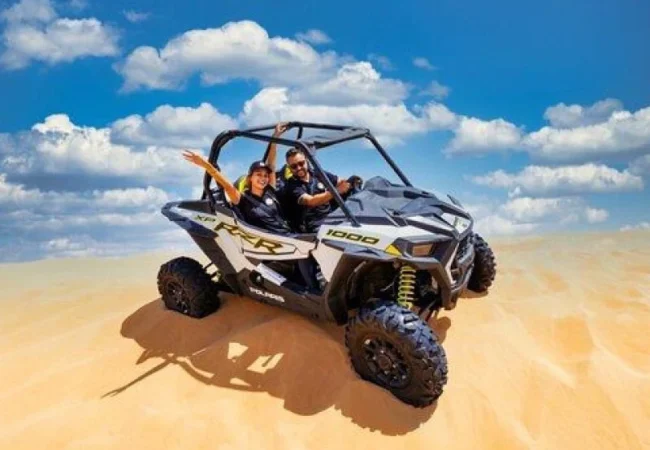
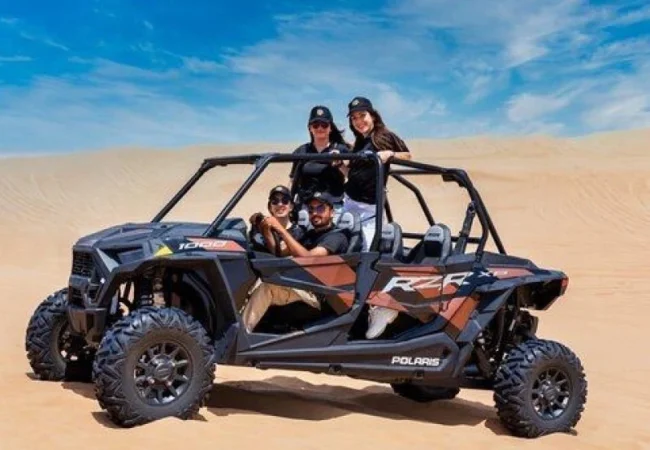
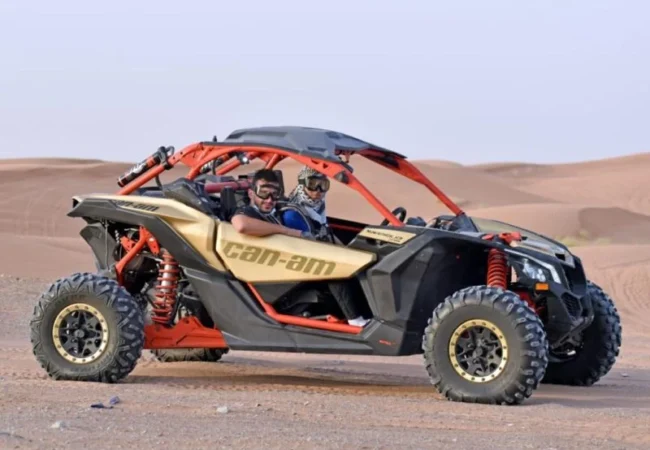
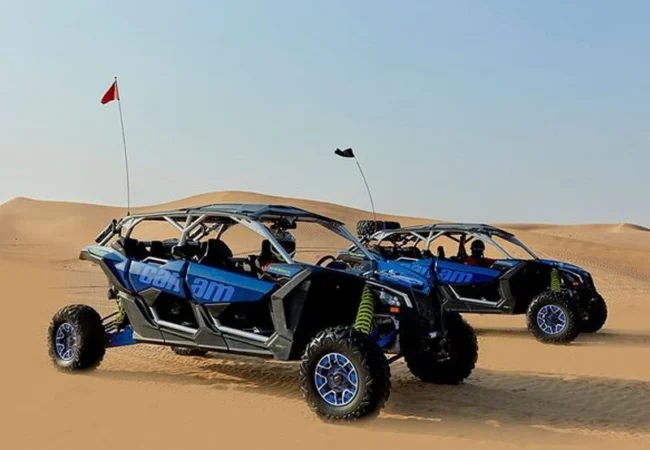
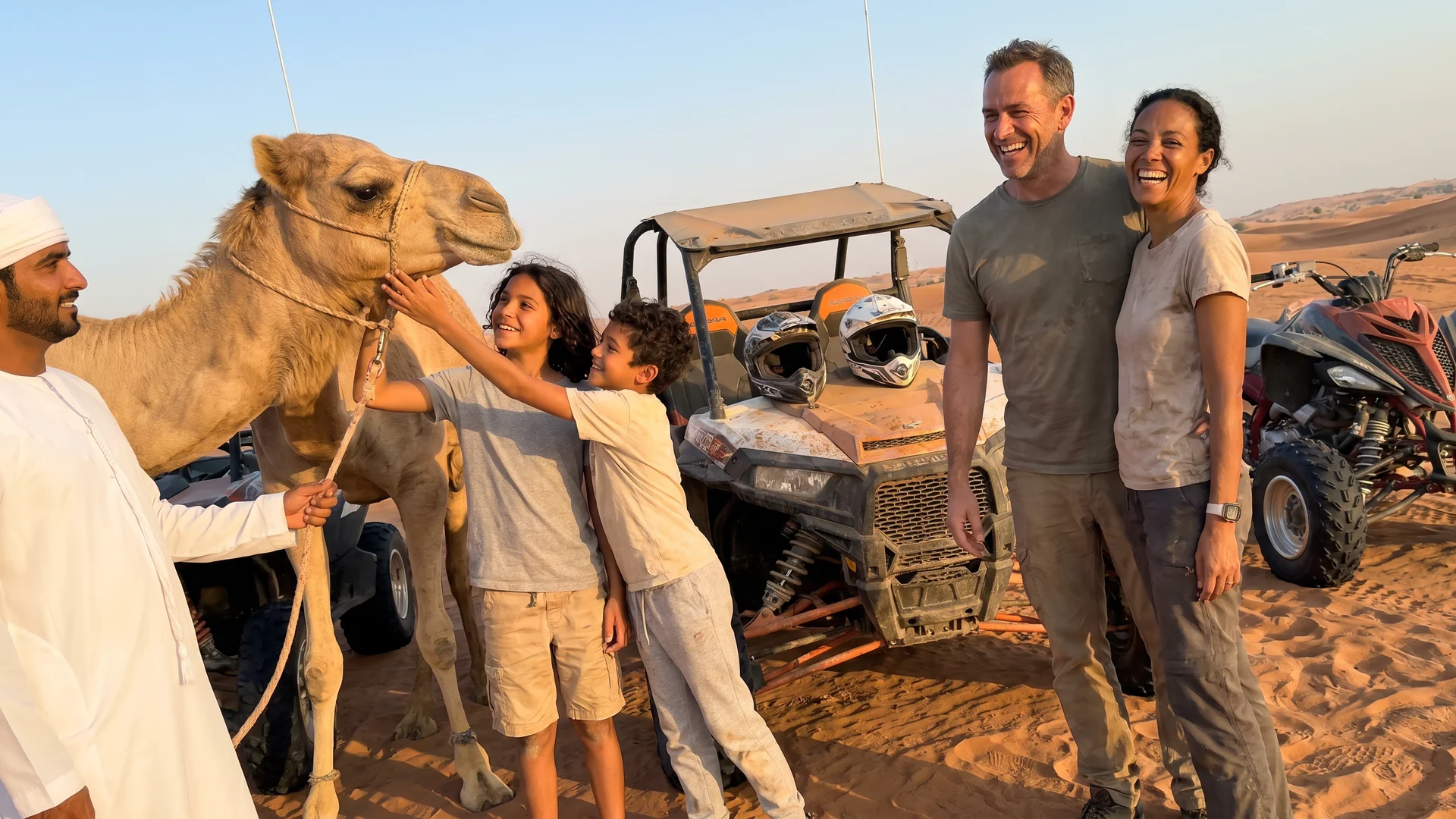
What actually fits into one hour of quad biking?
More than the number suggests. A typical hour breaks into a few minutes of helmet-fitting and briefing, a short warm-up lap on flat sand, then somewhere close to forty minutes of actual dune riding with the guide setting the line.
Sixty minutes sounds like a tight window until it gets broken into its actual pieces. First comes the helmet, then the walkthrough — throttle response, braking, staying balanced through the turns, and knowing which signal means stop right now — call it five to eight minutes, rarely longer, since the guide has run this exact briefing hundreds of times and knows which parts riders actually need repeated. From there it is a short lap on level sand while the guide watches how each rider handles the machine, another few minutes, before the real dunes start.
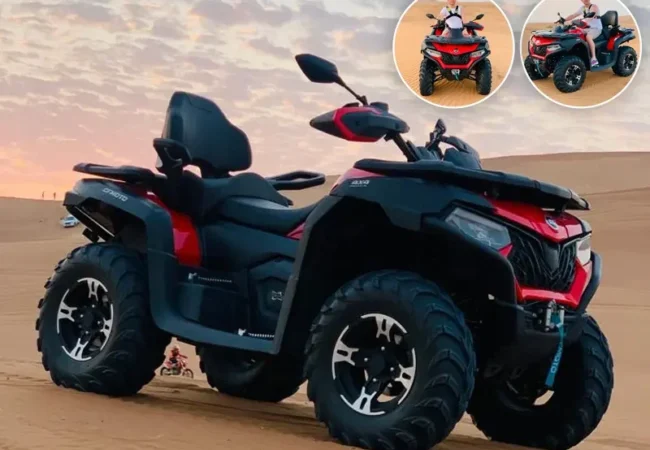
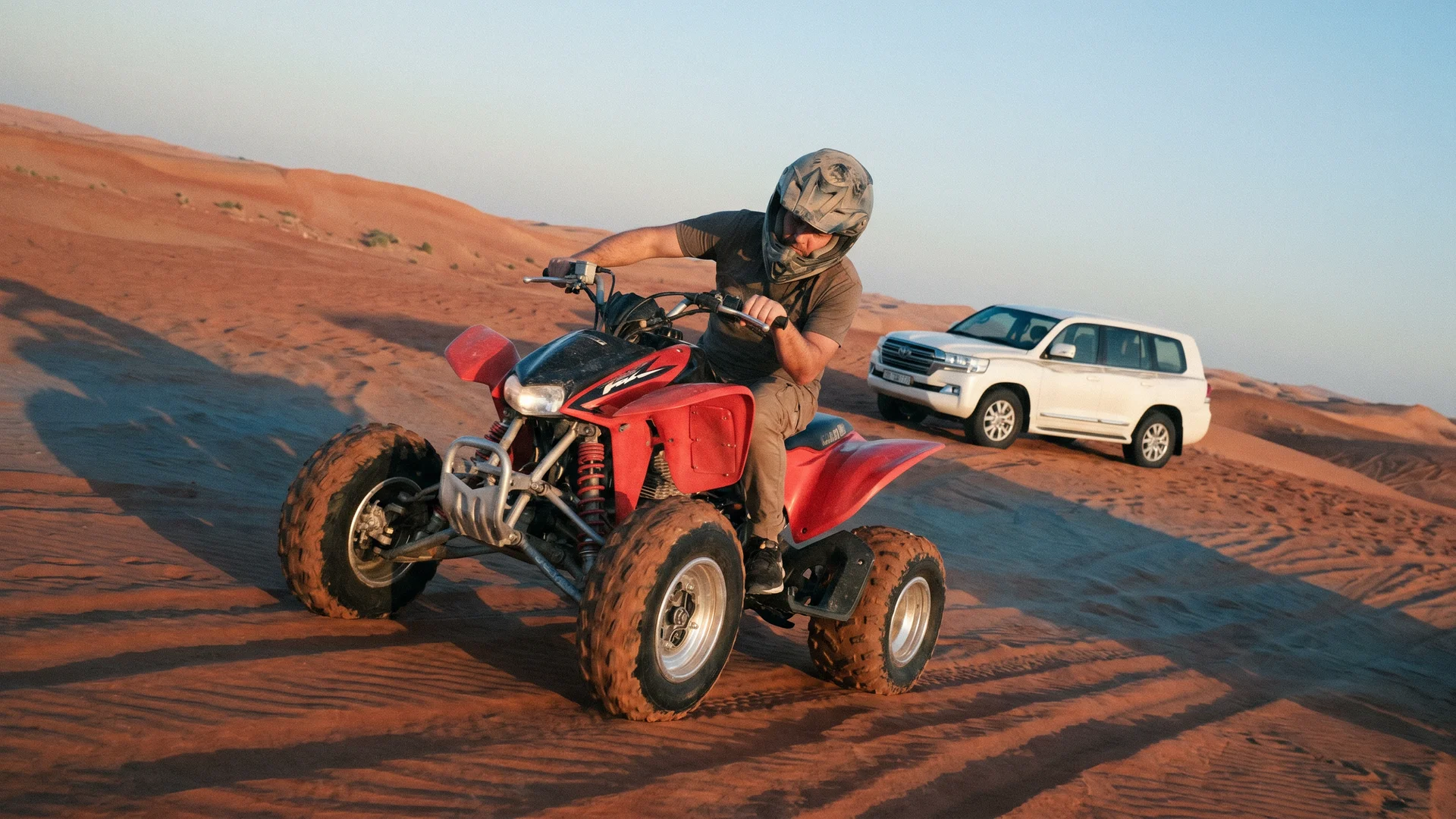
What is left after that opening stretch is the part people actually came for: bowls, ridges, a lead guide picking the route and adjusting the pace to whoever is riding slowest in the group. On the 220cc or the standard 400cc, that usually works out to somewhere in the region of forty minutes of continuous riding, not sixty, and that gap between the advertised hour and the riding time inside it is the single most common thing first-timers get wrong when picturing the booking.
None of this is padding stacked onto the session to make it feel longer than it is. Skip the briefing and the warm-up gets skipped too, and skipping the warm-up is how riders end up on a dune face they are not ready for. The pieces that are not pure riding time are the reason the riding time that follows goes smoothly instead of ending early with someone stuck or overwhelmed.
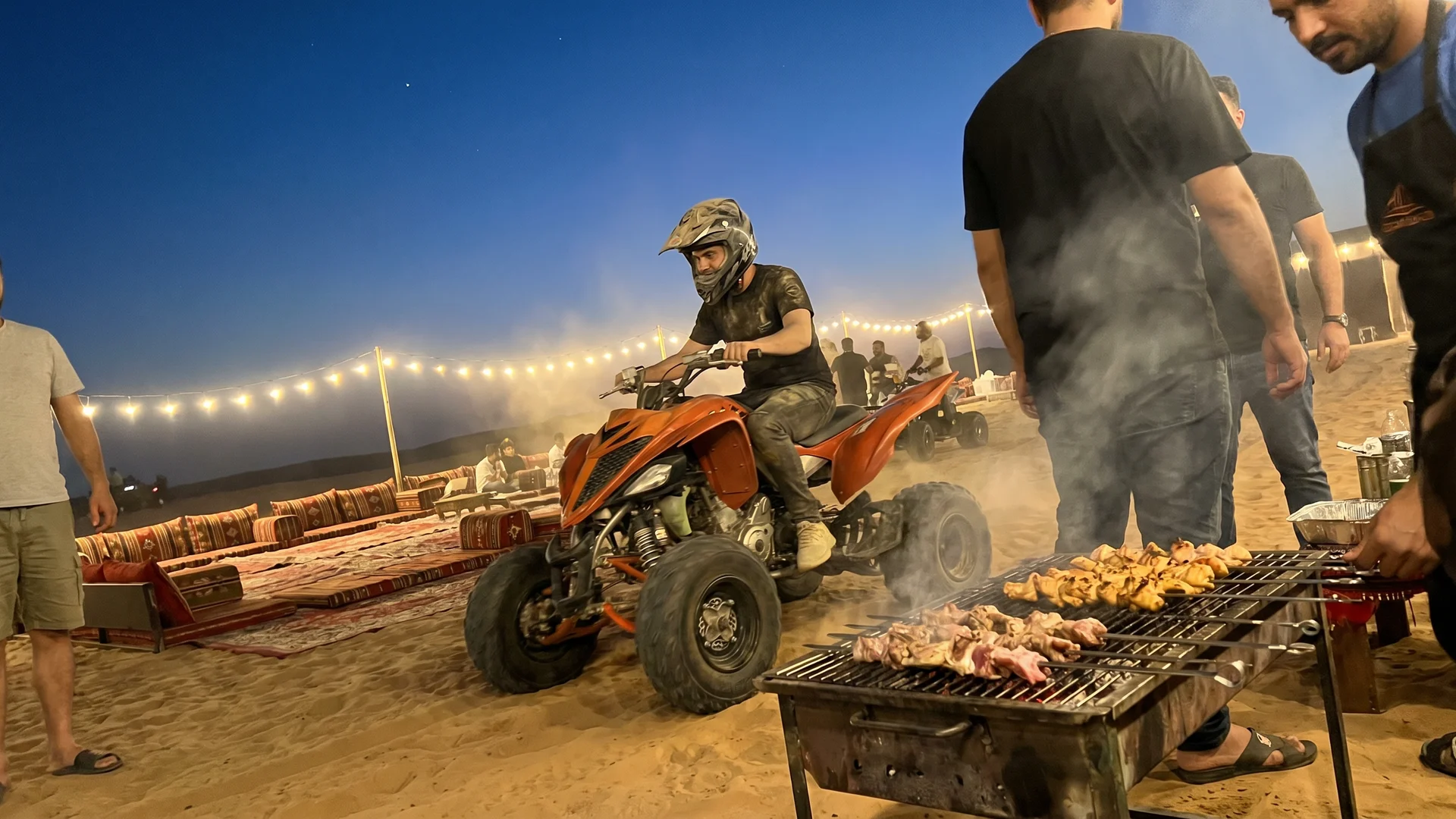
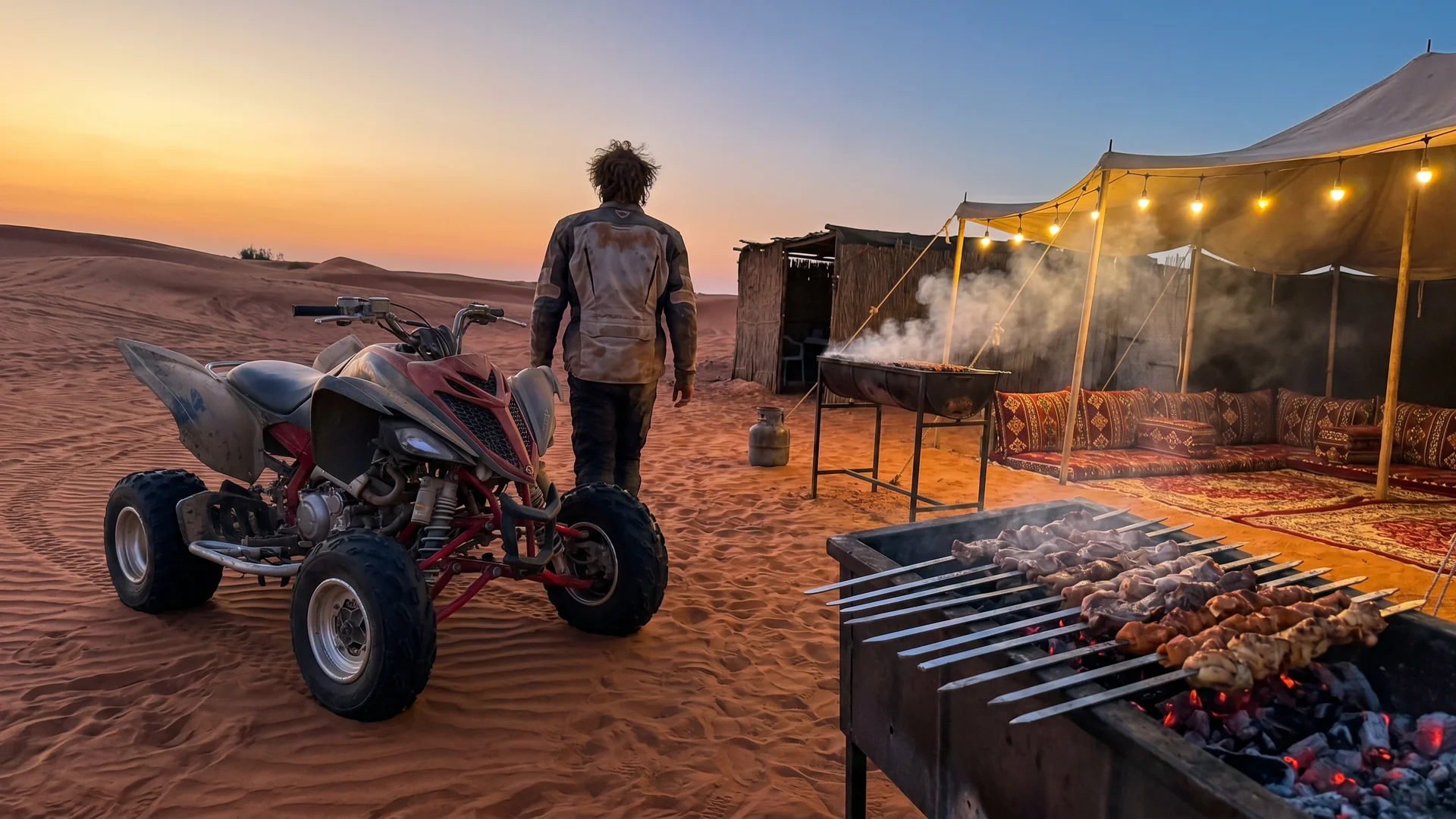
Combo bookings change this shape completely, worth flagging early. Add the evening safari and BBQ and the one riding hour stays exactly the same length — it just gets bookended by a Land Cruiser leg and a camp dinner that were never part of the original sixty minutes to begin with.
Is one hour long enough for a first-timer, or too short to enjoy?
Long enough on the 220cc or 400cc, where the warm-up genuinely doubles as extra practice time. It starts to feel short only on faster machines like the Raptor, where riders are still learning its full range right as the hour runs out.
First-timers tend to arrive assuming they will spend the whole hour nervous, and that is not really how it plays out on the machines built for a first ride. The 220cc responds slowly enough that the warm-up lap functions as genuine extra practice rather than a formality to get through, so by the time the real dunes start, most of that early nervousness has already burned off on its own.
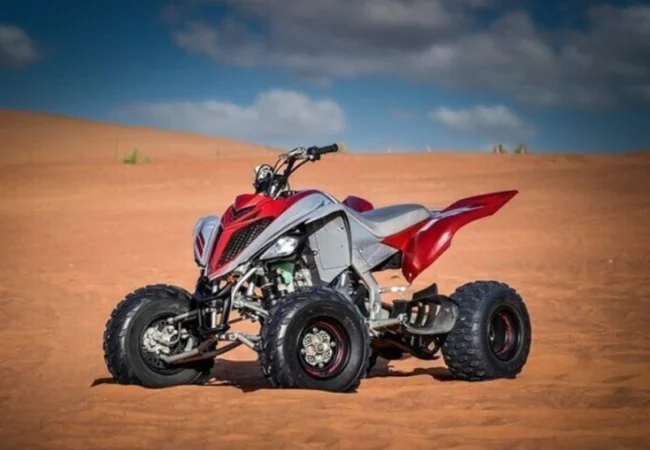
Where the maths tightens up is the faster end of the fleet. Choose either of the fleet's quickest machines — the Raptor or the 625cc sport quad — for a first-ever ride, and an hour barely covers getting comfortable with how much throttle response is actually sitting under your hand, let alone riding it with any real confidence. Neither machine is off-limits to a beginner, but neither one is built around a single short session either — they reward a rider who has already spent an hour or two on something gentler first.
There is a second-guessing pattern worth naming honestly: people who assume "enough" means racing flat out for sixty straight minutes, and worry an hour cannot possibly satisfy that. It is not really built for that pace in the first place. Between the guide managing the group's speed and a genuine warm-up built into the session, the hour reads as measured rather than frantic, and first-timers consistently report it feeling like the right amount rather than a countdown they were watching.
If there is real doubt about whether an hour will feel like enough, the honest fix is not to skip booking — it is to name that doubt on WhatsApp before choosing a machine. The 220cc-versus-400cc question and the enough-time question get answered by the same conversation, and what to weigh before you pick walks through exactly that.
How does one hour compare to the two-hour or half-day options?
Two hours roughly doubles the actual dune-riding portion rather than the whole session, since the briefing and warm-up stay a fixed cost either way. A half day tends to suit groups mixing quads with a buggy or safari rather than quad time alone.
Step up from one hour to two and the fixed pieces of the session — the briefing, the warm-up lap — do not grow with it. What actually doubles is the riding block that comes after, so the proportion of the booking spent moving through the dunes climbs noticeably, rather than merely adding more of the same slow start twice over.
Where the two-hour step-up earns its price most clearly is on a machine like the Grizzly 450cc, built for exactly this. Heavier and more planted than the standard fleet, it is genuinely wasted on a short loop and comes into its own once there is enough time to actually cover a longer route rather than turning around just as it starts to feel settled.
A half day is a different shape of booking entirely, and rarely just "more quad." It tends to mean a quad hour followed by a buggy session, or a quad paired with a safari and camp, rather than three or four straight hours on the same machine. Riders chasing pure seat time on one quad are usually better served booking the two-hour slot than assembling a half day out of mixed activities.
None of these tiers are fixed the way the standard hour is. The two-hour and half-day options both get quoted on request rather than posted machine by machine, so the honest way to compare them against the standard hour is a WhatsApp message naming which machine and how long, not guesswork from the price table alone.
Does the hour include the safety briefing, or is that extra time on top?
Included, not extra. The helmet fitting, the controls walkthrough and the warm-up lap all sit inside the booked hour, the same way they do on every machine in the fleet regardless of session length.
This is worth stating plainly because it is the single easiest assumption to get backwards. Some activities time the clock from the moment the main activity starts and treat everything before it as a free add-on; quad sessions here do not work that way. The booked hour starts at the briefing, not after it.
The reasoning is less about billing and more about what the briefing actually does. A rider who skipped the throttle-and-brakes walkthrough is a rider the guide cannot safely put on a real dune, so treating it as billable time rather than a free extra keeps the incentive lined up correctly — nobody is rushing through it to protect riding minutes, because rushing it does not free up any extra time anyway.
Where this becomes genuinely useful is in planning your actual day around it. If a hotel pickup is booked alongside the session, the travel time sits outside that hour entirely — it is the briefing and warm-up specifically that live inside it, not the drive out to Al Lahbab. Knowing that distinction in advance is what stops someone budgeting an hour for the whole outing and being surprised when the return drive adds another chunk on top.
Riders on a second or third visit sometimes ask whether a familiar face at check-in shortens the briefing next time. It does not, not on the safety side — the warm-up assessment runs for every rider, every session, no exceptions for returning faces. What moves faster for a repeat rider is the beginner explanation portion, not the actual check itself, and the full list of what is included with every session stays fixed regardless of how many times you have been out.
Is a one-hour session better value than a longer one, per minute of actual riding?
Close to it, since the fixed briefing cost is proportionally larger on a short session — but stretch to two hours on a machine like the Grizzly and the per-minute riding value edges ahead, because that same fixed cost gets spread across double the dune time.
Value-per-minute is the right way to actually compare these tiers, rather than staring at the total price alone. An hour carries a fixed cost in briefing and warm-up time no matter which machine gets booked, so the shorter the session, the larger a slice that fixed cost takes out of the total. Stretch to two hours and that same fixed cost gets divided across a longer riding block, which is the honest reason the per-minute value edges toward the longer booking on paper.
On paper is doing real work in that sentence, though. The standard hour still wins for anyone whose actual limiting factor is not money but stamina or attention span — steering a quad through sand runs almost entirely on hips, forearms and core, and that catches first-timers off guard well before an hour is up. A cheaper minute of riding that nobody has the energy left to enjoy is not obviously better value than a slightly costlier hour spent fully present for all of it.
The 400cc double at AED 350 for two riders sharing one machine is worth flagging here too, since it changes this maths entirely for a pair. Splitting one fee across two people for the hour makes it, minute for minute and dirham for dirham, one of the strongest value bookings on the whole price table — provided both riders are genuinely fine with only one of them holding the throttle.
The honest read: book the standard hour if stamina or a tight schedule is the real constraint, and only reach for two hours specifically because more riding time is what you actually want, not because the per-minute arithmetic alone makes it sound like the smarter choice.
Who is a one-hour session best suited for?
Quick visitors slotting the desert into a packed itinerary, tight-schedule bookings between flights or meetings, families mixing a kids' track with adult dunes, and anyone testing whether quad biking is something they even enjoy before committing to more.
Think about a typical short-stay visitor juggling the Burj Khalifa, the fountain show and a shopping mall or two inside a single week. A single hour of quad biking drops into a schedule like that without forcing anything else to move, which is exactly why it works as the default booking for anyone treating the desert as one stop on a longer list rather than the centrepiece of the trip.
Tight-schedule bookings are a close second use case, and a genuinely common one. Someone with a free afternoon between a work meeting and a flight, or a stopover passenger with a handful of hours in the city, gets a real desert session without it eating a day they do not have. The hour-based structure exists precisely because not every visitor has a spare half day to give it.
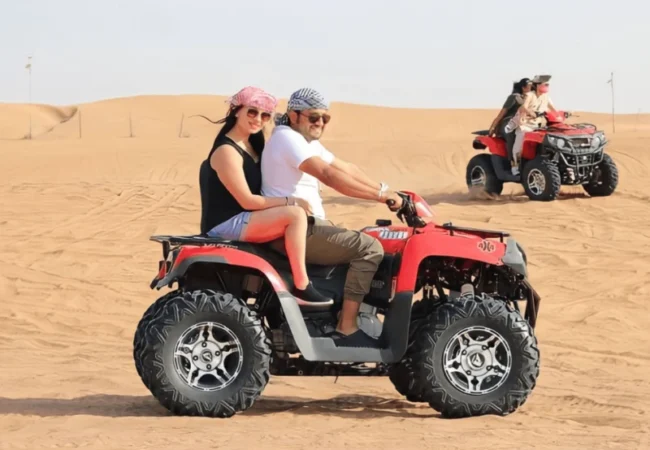
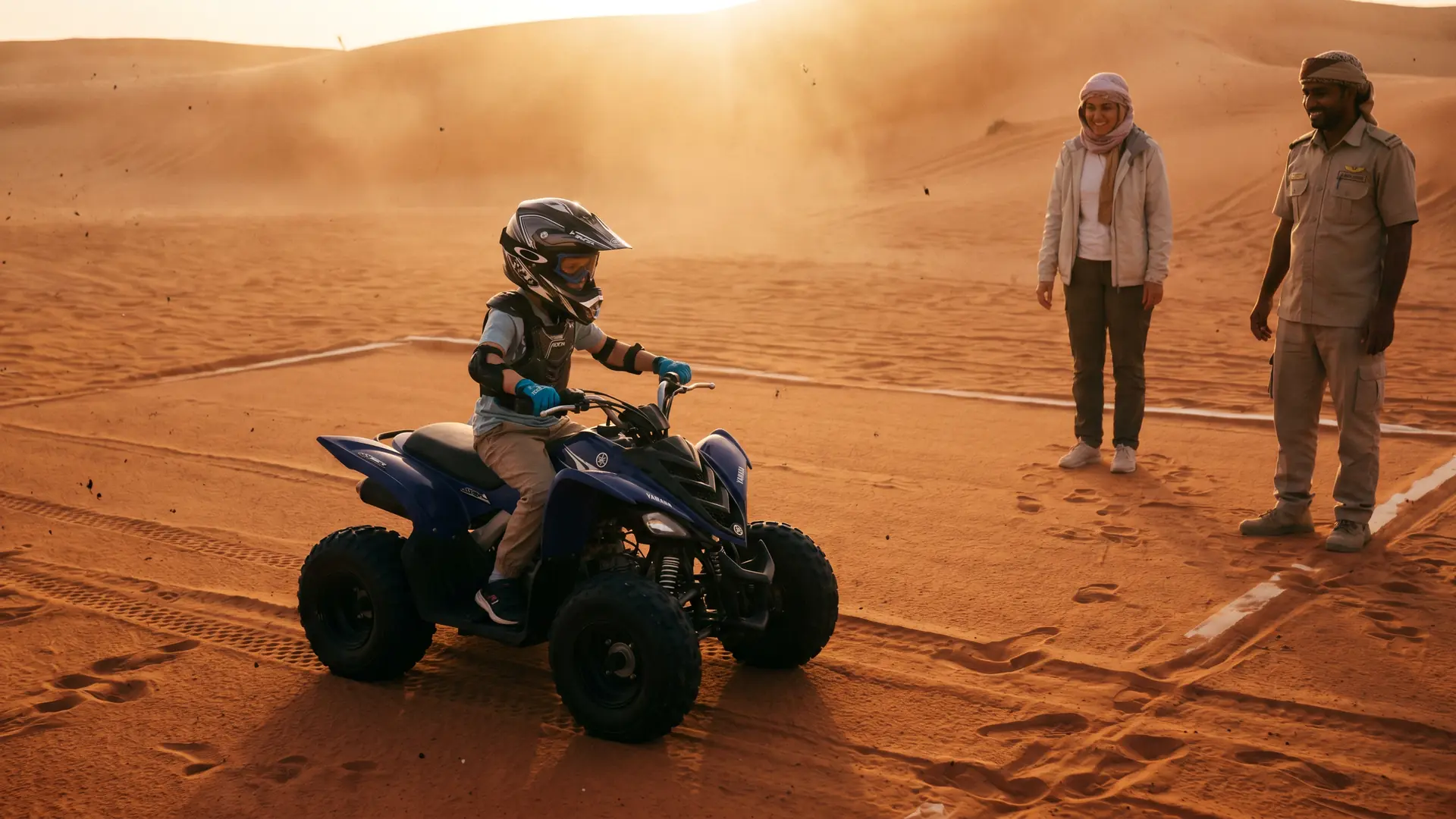
Families land here differently. Rather than everyone sharing one pace, younger riders spend their hour on the supervised 90cc track while parents take the open dunes on a proper machine, both wrapping up on roughly the same clock instead of one group waiting around for the other to finish.
And then there is the simplest reason of all: never having tried it before and not wanting to commit two hours or a half day to something that might not be your thing. An hour answers that question completely, at the lowest possible cost in both time and money, and either sends you home satisfied or tells you clearly that a longer booking next time is worth planning around.
Can you extend a one-hour booking on the spot if you want more time?
Usually, if the next slot on your machine is free — but it is a request made in the sand, not a guarantee, so treat it as a genuine possibility rather than something to plan the whole day around.
It happens often enough that guides are used to the question, typically from someone on the 400cc or the Raptor who was not expecting the hour to go by quite that fast. Whether it can actually happen comes down to one thing: is that same machine free for the next slot, or is somebody else already booked onto it.
Quiet weekday sessions make an on-the-spot extension the easiest kind of yes — plenty of machines with nobody booked directly after them, and a guide who can simply keep the session running a little longer without disrupting anyone else's booking. A packed Friday or Saturday afternoon is a much harder ask, since the next rider is often already en route for that exact machine.
The KTM dirt bikes are the clearest real example of this whole idea, because the tiers are already built into the price table rather than left as a maybe. AED 850 covers one hour and AED 1,250 covers two, a fixed step-up rather than a negotiated one, and that structure exists precisely because enough riders were asking to extend that it made more sense to price it properly than to keep treating it as a special request.
The safest version of a longer session is still deciding in advance rather than hoping the sand cooperates: book two hours outright, or ask on WhatsApp about the step-up while arranging the original booking. On-the-spot extensions genuinely happen, but they depend on what else is on the schedule that day, and a booking made ahead of time never has to depend on anything.
People also search for
Guide FAQ
If I book one hour and love it, can I immediately rebook for a second hour that same day?
Yes, if the machine or an equivalent one is free for the next slot — it works the same as any on-the-spot extension request, just framed as a fresh booking rather than a continuation. On a quiet day it is often seamless; on a packed weekend the machine you loved might already belong to the next rider.
Does a one-hour quad booking cost less per minute than the two-hour option?
No — per minute, the two-hour booking edges ahead slightly, since the fixed briefing and warm-up cost spreads across more riding time. The one-hour booking still wins on total price and on not asking for two hours of stamina, which matters just as much as the arithmetic.
Can I book two separate one-hour sessions on two different machines in the same visit?
Yes, and it is a genuinely popular way to compare machines rather than committing to one for a longer block — a 220cc hour followed by a 400cc hour, for instance. Each is booked and priced separately rather than as a single combined session.
Is the one-hour KTM dirt bike booking the same length as the one-hour quad booking?
Both are booked as one hour, but the KTM's hour is the legal minimum on that machine — there is no shorter option — while quad sessions are simply the standard default rather than a fixed floor. The riding-history screening also applies to the KTM regardless of session length.
If my one-hour slot starts late because of traffic, does the hour still end at the original time?
No — the hour is measured from when the session actually begins, not the time printed on the booking. Guides do not shortchange a rider for arriving late through no fault of their own, though a very late arrival can affect what is left of the daylight for that route.
Does the one-hour price change if I only end up riding for forty minutes?
No, the price is fixed to the booked hour rather than metered to the minute. Choosing to stop early, for tiredness or any other reason, does not reduce the fee or carry over unused time to a future visit.
Can a one-hour booking be split between two riders taking turns on the same machine?
Not on a standard single-rider quad — the booking is tied to one rider for the full hour, and swapping mid-session is not offered on those machines. The 400cc double is the actual answer for two people wanting to share one hour, since both seats are occupied at once rather than in turns.
Is a one-hour quad session enough time to also get good photos?
Yes — the ride includes brief stops along the route specifically for photos, and they do not require booking extra time separately. Riders wanting a longer, more deliberate photo stop should mention it to the guide at the start, since the standard stops are quick rather than a dedicated shoot.
Do same-day one-hour bookings ever cost less than booking a day ahead?
No — price is set by the machine, not by how far ahead you book or how last-minute the request is. Booking ahead helps you get the specific machine and time you want; it does not change what that hour costs.
If I am not sure whether to book one hour or two, can I decide once I am already there?
It is safer to book the hour you are fairly confident about and treat a second hour as a possible on-the-spot extension rather than the plan. Machines get booked out in blocks, so showing up undecided risks the two-hour version simply not being available that day.

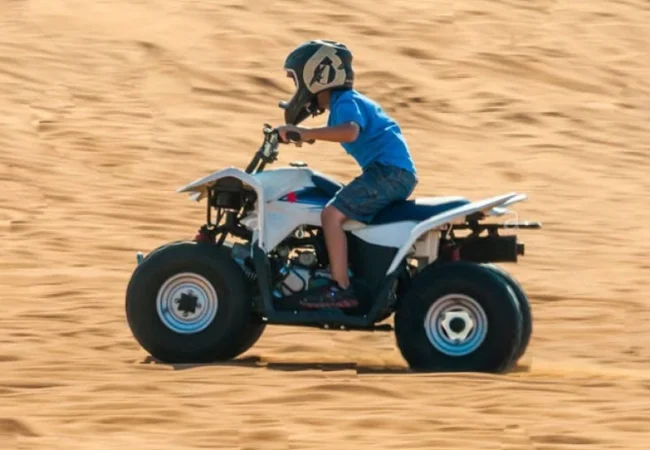 AED 150